"... for their coverage of other people who have been canceled. 'There is a word for this, but I’m not sure what it is. "Irony" is insufficient. If we cancel everyone... who will be left?'"
I couldn't untangle the story. I was almost interested enough, but ultimately the complexity outweighed the hope of enlightenment. Was that also the problem with the podcast? I don't know. Did the podcast about racism have a racism problem?
You tell me. I'm just posting because I wanted to record the sentence, "Being 'cancel-adjacent' is exhausting." I think "cancel-adjacent" is a term worth remembering. And I've been fascinated lately by the tendency of younger people to use the word "exhausting" in their complaints.
Perhaps I was trying to explain institutional racism, or racism and Western Civilization, or racism and literature.... I have no recollection of this conversation. It sounds like my younger self — the self not yet exhausted explaining racism to white people.... Explaining racism is exhausting. It’s exhausting to explain to people who don’t believe you, or who look at you with blank expressions. Or, worse, who ask, “How do you know that happened because of race?”... Racism is exhausting.
Hi there, as someone with significant Neanderthal DNA, I'm begging you to stop being an obstructionist dork and help the American people. Thanks. pic.twitter.com/k37wOeMHrM
Because I follow the Twitter feed of the erstwhile NYT columnist Bari Weiss, I noticed that there's a new group that calls itself FAIR — The Foundation Against Intolerance and Racism. Here's their video:
That's on such a high level of abstraction that it hard to understand what's really going on there. The assumption is that you'll recognize at least some of the names/faces and trust their authority. They seem to be banding together as a correction to the excesses of social-justice activists. But what exactly? Are we to trust them as experts, with details to come later?
I found their website, here, and the front page has that video embedded next to the words "What is FAIR?" So I'm stuck in a loop. "What is FAIR?" is the question I had after watching the video. So I watched it again. As far as I can tell, based on the words spoken, it is a forthright demand for the old-fashioned color-blindness approach to racial justice: There is "one race, the human race."
Given the famous names who've joined together — Steven Pinker, John McWhorter, Glenn Loury, Bari Weiss, etc. — I would expect news coverage of this organization, which seems to have been announced yesterday. But when I did a Google News search, only one thing came up, a NY Post item titled "Booksellers were unprepared for Dr. Seuss ban as sales skyrocket."
That's not an article about FAIR, just a reference to it at the end of an article about the Seuss crisis:
A Web site has sprung up called BannedSeuss run by the Foundation Against Intolerance and Racism that says: “Erasing books is insanity. Stand up for our common humanity.”
Here's the BannedSeuss website. Ah! It has the full text and pictures of "And To Think I Saw It on Mulberry Street" (a book, that, I think, is cancelled because of the line "A Chinese man who eats with sticks" and the picture of a man whose eyes are represented by short angled lines when everyone else in the book has eyes represented by dots).
Back to the NY Post:
The Foundation behind it claims to be a non-partisan organization “dedicated to advancing civil rights and liberties for all Americans, and promoting a common culture based on fairness, understanding and humanity.” It did not return an email from Media Ink seeking comment. None of the banned books could be found at the Barnes & Noble in Manhattan’s Union Square on Thursday even though an associate said he believed the store had “And To Think I Found It on Mulberry Street” in stock as recently as Wednesday. Other Dr. Seuss books were still available for purchase, however.
How quickly the mind erases the past. At the NY Post, the title has already deteriorated from "And To Think I Saw It on Mulberry Street" to "And To Think I Found It on Mulberry Street." Just imagine how racist this book would become if we lost access to it!
I celebrate the BannedSeuss website. I'm not a copyright expert, but I encourage the defense of the practice of publishing the entirety of a book that has been banned. It's fair use, no? It's only by seeing the whole thing that we can know how little was even questionable about this 70-year-old book.
Now, back to the FAIR website. I click through to the "About" page. There's some specificity here. I'll select the most usefully specific material:
We advocate for individuals who are threatened or persecuted for speech, or who are held to a different set of rules for language or conduct based on their skin color, ancestry, or other immutable characteristics....
We believe bad ideas are best confronted with good ideas – and never with dehumanization, deplatforming or blacklisting.
We believe that objective truth exists, that it is discoverable, and that scientific research must be untainted by any political agenda.
We are pro-human, and promote compassionate anti-racism rooted in dignity and our common humanity.
There's a pledge: "I seek to treat everyone equally without regard to skin color or other immutable characteristics. I believe in applying the same rules to everyone, and reject disparagement of individuals based on the circumstances of their birth... I am open-minded. I seek to understand opinions or behavior that I do not necessarily agree with. I am tolerant and consider points of view that are in conflict with my prior convictions.... I recognize that every person has a unique identity, that our shared humanity is precious, and that it is up to all of us to defend and protect the civic culture that unites us."
There seems to be an effort to infuse the work with the kind of religion that Martin Luther King Jr. brought to the civil rights movement. They seek "redemption and reconciliation" and "to defeat evil." And: "Suffering can educate and transform. We will not retaliate when attacked, physically or otherwise. We will meet hate and anger with compassion and kindness. Choose Love, Not Hate. We seek to resist violence of the spirit as well as the body. We believe in the power of love."
Oh! Maybe I shouldn't use the word "slant" in the vicinity of the Dr. Seuss dispute. It's the worst word he ever used. Oh, no, it's not cute:
That's from "If I Ran the Zoo," a 1950 book that Dr. Seuss enterprises has just withdrawn from publication.
Vox writes its article at a slant on a website where everything must be a rant. I'm not staying there long. I won't and I can't. But I noticed this one thing that seemed slightly wacky — a press conference question aimed at poor Jen Psaki:
Q A question about Dr. Seuss, since this may be the only day that you can bring up Dr. Seuss in the briefing room. It is National Read Across America Day. It’s also Dr. Seuss’s birthday. Both former Presidents Obama and Trump mentioned Dr. Seuss in their Read Across America Day proclamations, but President Biden did not. Why not?
MS. PSAKI: Well, first, the proclamation was written by the Department of Education, and you could certainly speak to them about more specifics about the drafting of it. But Read Across America Day, which has — you’re right, has not existed forever; it has only been around for a short period of time — elevates and celebrates a love of reading among our nation’s youngest leaders. And the day is also a chance to celebrate diverse authors whose work and lived experience reflect the diversity of our country. And that’s certainly what they attempted to do or hope to do this year. And as we celebrate the love of reading and uplift diverse and representative authors, it is especially important that we ensure all children can see themselves represented and celebrated in the books that they read.
Q So does the omission have anything to do with the controversy about the lack of diverse characters in the author’s books?
MS. PSAKI: Well, again, I think it is important that children of all backgrounds see themselves in the children’s books that they read. But I would point you to the Department of Education for any more details on the writing of the proclamation.
It was a hot topic and she made it quite dull. If you want to be a press secretary, that's something to mull.
"The Eyes of Texas" is a song traditionally played at the end of football games, with players remaining on the field to sing the song along with the fans. Recently, all the players except the quarterback left the field.
Students have been petitioning to get rid of the song — something I wrote about last October. I didn't take a position on the racial problem with the song and whether it's enough to overcome the pull of tradition, but I did undertake my own independent analysis of the lyrics:
The state has eyes and is always watching you: "The Eyes of Texas are upon you/All the livelong day/The Eyes of Texas are upon you/You cannot get away/Do not think you can escape them/At night or early in the morn/The Eyes of Texas are upon you/'Til Gabriel blows his horn."
There really is something wrong with this song. It's oppressive even if you don't know the background story. It speaks of surveillance and endless oppressive work. Maybe a lot of college kids think the song is just funny and surreal. Eyes that you cannot escape.
She means well. Is she anxious about what else she may be unknowingly doing... such as depriving children of the fun of reading Dr. Seuss or generating morbid fears about strange manifestations of racism or being too subservient about taking instruction from dull people who are oversure of their puritanical notions of racial correctness?
... I pulled out the extensive collection of Dr. Seuss books that I have in my home and re-read them with a critical lens only to find that the themes of anti-Blackness, white supremacy, and Orientalism are garishly prevalent. I have used Dr. Seuss books in my classroom for the last ten years. I feel disgusted knowing that I not only celebrated these texts, but the life of Theodore Geisel. Dr. Seuss books will no longer have a place in my home. The messages that children absorb through literature will impact their racial beliefs. Without proper support in navigating the harmful messages from books like Dr. Seuss’s, children are likely to transfer what they read to their play and social life....
Go to that link to see the suggestions of books to read in place of particular Dr. Seuss books. The book covers are depicted, so you can get a sense of the kind of drawing that anti-Seussers think could work as a substitute for his highly idiosyncratic work. But these substitutes just have blandly realistic, sentimental illustrations that depict people of color. If you want to replace Dr. Seuss, the first thing you'll need some exciting, inventive drawing! And you've got to have a little edge to the story. It can't be just love is important and nice people are nice.
"... that 'racism is over,' that 'white supremacy doesn’t exist,' or 'white privilege doesn’t exist,' or that I defended the use of blackface or said horrible things about black teenagers in general. I’m surprised by how quick some colleagues who barely know me were prepared to accept those accusations and even add more on a Times alumni Facebook page. Someone to whom I don’t think I’ve spoken since 1994 said 'calling him only a racist is being nice.' An editor I happily worked side by side with in 1989 and have had brief but cordial chats with maybe once every ten years when we bump into each other on the street said I seemed 'dismissive of people of color and their views' back then. Someone I thought I’d been very nice to when she left the paper attacked me for using the expression 'third world' in a story that was, as always, approved by several Times editors.... My girlfriend thinks I have a high-functioning Asperger aspect to my personality — I’m empathic about suffering but I also very much misread audiences.... [W]hat’s happened to me has been called a 'witch hunt.' It isn’t. It’s a series of misunderstandings and blunders. I may be the only living Times reporter who has actually covered a witch hunt — in Zimbabwe in 1997. They inevitably end worse for the accused. I’m at least getting my say."
From "NYTimes Peru N-Word, Part One: Introduction" by Donald McNeil (Medium). Interesting how he chooses to play the disability card with that "high-functioning Asperger aspect to my personality." I wonder how much of what the wokesters call "whiteness" (and maleness) could be repackaged as "high-functioning Aspergers" and received with some empathy as part of the rainbow of diversity.
Chief Mabhena is the first woman to be a chief of the Ndebele tribe, and her nomination by her village caused a furor... ''A chief is a leader in war,'' said George Moyo, president of the Ndeb ele Cultural Society, ''and there are secrets of warriors, like tactics and intelezi, that a woman is not allowed to know.'' Intelezi is war medicine sprinkled on soldiers. Mr. Moyo, who lives in Bulawayo township 60 miles north of Nswazi, is a sangoma, or herbal doctor, and brewing intelezi is something he knows about.... Chief Mabhena says Mr. Moyo needs to realize that culture is dynamic and that the army, not chiefs, makes war nowadays....
"The martyrdom of Black Americans is very prevalent among particularly white liberals and we see that, I think, in how we celebrate MLK and how a lot of these folks will uphold the whitewashed and martyred idea of Dr. King without actually exploring his radical nature and radical ideology.... [It was] the typical well meaning white liberal kind of paternalistic type of racism... She called to apologize in a way and it just really rang hollow to me. It rang like somebody that, one, didn’t reflect on what she said before she heard that I was upset. She also resorted to it as an individual hurt, in saying sorry she hurt me, without an ability to see a wider level and see as what it was, racist behavior, racist mentality. And I kind of started to say that and I’m like, 'You’ve got a lot of work to do.' And she said, 'I’m trying to do that work. Maybe you could help me.' And I told her that it’s not for me, I’m not here to do the work for you. You’ve got to do it yourself."
Braunginn utters a long but important phrase: "the typical well meaning white liberal kind of paternalistic type of racism." Consider how regarding Floyd as a blessed martyr is a kind of racism. Understand why Braunginn was so outraged over this that he quit his alliance with some well-meaning Madison liberals.
"... but I can’t remember seeing it for a while now. (And I deliberately say 'see' it instead of 'hear' it because I’ve only ever seen it written, never heard it out loud.) Could it be that the word started to seem out of touch because we’ve been realizing how fragile we all are?"
Writes my son John on Facebook, and I think he's suggesting something about our heightened awareness of death and illness during the pandemic.
I responded over there:
Based on my search for "white fragility" in the NYT, with the results ordered newest first, I'd say it was very common up through October. Since October, there's only one appearance, in a little thing in December about what books New Yorkers read in the past year: "As nationwide discussions erupted over the summer around race and racism, demand for books on the subjects surged across the country, a trend reflected in the city’s libraries. Titles like 'White Fragility: Why It’s So Hard for White People to Talk About Racism' by Robin DiAngelo were among the most popular in some boroughs." What changed after October? To ask the question is to make the answer obvious.
Before that December item, there were articles containing the term "white fragility" on October 29, October 22, October 6, September 27, September 17, September 6, September 1, August 31, August 11... You get the picture.
But "fragility" was a vogue word before last year's obsession with Robin DiAngelo's book. Even if the election — the answer I thought was obvious — explains the disappearance of "white fragility," we might also be seeing a disappearance of interest in "fragility" as used in the book "Antifragile" by Nassim Nicholas Taleb. If so, I'm inclined to guess that the over-prominence of DiAngelo's concept tired us all out.
And that's the irony of being fragile about fragility that John was musing about.
"... in some contexts. Mike Pesca, the host of 'The Gist,' a podcast on news and culture... made his argument during a conversation last week with colleagues on the interoffice messaging platform Slack. In a lengthy thread of messages, Slate staff members were discussing the resignation of Donald G. McNeil Jr., a reporter who said this month that he was resigning from The New York Times after he had used the slur during a discussion of racism while working as a guide on a student trip in 2019.... Jacob Weisberg, Slate’s former chairman and editor in chief [said]... 'I don’t think he did anything that merits discipline or consequences, and I think it’s an example of a kind of overreaction and a lack of judgment and perspective that is unfortunately spreading'... Joel Anderson, a Black staff member at Slate... disagreed. 'For Black employees, it’s an extremely small ask to not hear that particular slur and not have debate about whether it’s OK for white employees to use that particular slur,' he said."
ADDED: If a place of business wants to have zero-tolerance rule that says you will lose your job if you ever say the syllables of the n-word, that's one thing. But I don't see how the policy can be, as Joel Anderson suggests, that it only applies to white employees. That's overt and unsubtle race discrimination, and it would, I think, be hard to argue that it's not a violation of statutory law. Would Anderson support a rule that required the firing of black employees who happen to slip into say the word? I don't think I've ever heard anyone push for a rule like that. So I think the employer would be well advised to take the context of the saying of the word into account.
AND: A race-neutral zero-tolerance rule would create a much greater risk for black people. I think it's very easy for white people to avoid ever saying the word. Some just don't think we should be so repressed and sensitive about the word — as opposed to its use as an insult. But if the rule is you'll be fired if you ever say it, regardless of context, white people will abide by the rule.
"... and one realizes how slippery it is, too. As defined by [author of 'White Fragility' Robin] DiAngelo, white fragility is irrefutable; any alternative perspective or counterargument is defeated by the concept itself. Either white people admit their inherent and unending racism and vow to work on their white fragility, in which case DiAngelo was correct in her assessment, or they resist such categorizations or question the interpretation of a particular incident, in which case they are only proving her point. Any dissent from 'White Fragility' is itself white fragility. From such circular logic do thought leaders and bestsellers arise. This book exists for white readers. 'I am white and am addressing a common white dynamic,' DiAngelo explains. 'I am mainly writing to a white audience; when I use the terms us and we, I am referring to the white collective.' It is always a collective, because DiAngelo regards individualism as an insidious ideology. 'White people do not exist outside the system of white supremacy,' DiAngelo writes, a system 'we either are unaware of or can never admit to ourselves.'... Progressive whites, those who consider themselves attuned to racial justice, are not exempt from DiAngelo’s analysis. If anything, they are more susceptible to it. 'I believe that white progressives cause the most daily damage to people of color,' she writes. '[T]o the degree that we think we have arrived, we will put our energy into making sure that others see us as having arrived...'... It is a bleak view, one in which all political and moral beliefs are reduced to posturing and hypocrisy...."
"... was part of an army of women who worked as traveling Aunt Jemimas, visiting small-town fairs and rotary-club breakfasts to conduct pancake-making demonstrations at a time when the notion of ready-mix convenience cooking was new. I never knew about my grandmother’s work until long after she died... [W]hile researching a family memoir... I learned that she made good money and covered a region including Iowa, the Dakotas, Michigan, Wisconsin and Minnesota. She was often treated like a celebrity in small towns, but could not stay in local hotels. She kept an eye out for houses that had a small sign in the window that said 'TOURIST,' a code for homes that provided lodging and meals to black people.... As a family, we are offended by the caricature that Aunt Jemima represents, but deeply proud of the way my grandmother used the stage that was available to lift herself up. You see, in those days Aunt Jemima didn’t look like the lady you see on the box today. She was a slave woman, and Ione was expected to act and talk like a slave woman, using the kind of broken patois that blighted the full-page ads in magazines like Women’s Day and Life.... One of the things that irks me most about the Jemima brand is the way the mammy stereotype hijacked what should be an endearing image for black America and tried to turn it into something toxic. Most of us have someone in our family with fleshy arms and a loving smile who serves up cherished advice along with delicious food. They are our aunts and mothers and grandmothers. Our godmothers. Our queens. You tried to make us ashamed of what Aunt Jemima stood for."
From "Why did it take so long to set Aunt Jemima free?" by Michele L. Norris (WaPo). (Quaker Foods announced that it is retiring the Aunt Jemima brand because to "make progress toward racial equality.")
The syrup, sold in a matronly woman-shaped bottle, is accused of being rooted in mammy culture and was modeled after the body of Thelma “Butterfly” McQueen, the black actress who played Prissy in “Gone With The Wind.” The Jim Crow-era “mammy” character was often used to show that black women were happy working in white households....
That's news to me. I looked up Mrs. Butterworth on Wikipedia and it did not contain that information. I did learn that the voice for the character was done by Mary Kay Bergman, who looked like this:
"Her parents were Jewish," and she died by suicide at the age of 38 in 1999. She was the original lead female voice on "South Park."
Her characters included Liane Cartman, Sheila Broflovski, Shelly Marsh, Sharon Marsh, Carol McCormick and Wendy Testaburger.... Bergman credited South Park for pulling her out of a typecasting rut. 'I'm known for these sweet, cute little characters,' she said, noting her roles in various Disney films. "So I've been doing them forever. My agents were trying to submit me on shows that are edgy, and they're laughing, 'Mary Kay, are you kidding? No way!'" After Bergman's death, the two episodes "Starvin' Marvin in Space" (the final episode for which she recorded original dialogue) and "Mr. Hankey's Christmas Classics" (the final episode in which her voice was used via archive footage) were dedicated in her memory.
No comment on the role of Starvin' Marvin and Mr. Hankey in the quest for progress toward racial equality. RIP Mary Kay Bergman. Watch this (it's phenomenal):
Mrs. Butterworth voice at 1:11.
ADDED: Norris writes that her grandmother, in the role of Aunt Jemima had to use a "kind of broken patois." And I see in the comments that David Begley is asking, "Just asking, but isn’t 'broken patois' the language of today’s rap music?" Which makes me wonder, what's wrong with a patois? To answer my own question, I naturally look up "patois" in the OED.
I see that it's "dialect spoken by the people of a particular region (esp. of France or French-speaking Switzerland), and differing substantially from the standard written language of the country" or — and this is "frequently depreciative" — "a regional dialect; a variety of language specific to a particular area, nationality, etc., which is considered to differ from the standard or orthodox version."
I was intrigued by this example from "The Sheltering Sky" by Paul Bowles (who was born in New York City):
Then he remembered having heard that Americans did not speak English in any case, that they had a patois which only they could understand among themselves. The most unpleasant part of the situation to him was the fact that he would be in bed, while the American would be free to roam about the room, would enjoy all the advantages, physical and moral.
"And talk about their reading. What they do is listen. And talk about how they listened. What they do is never enough. This isn’t the time to circle up with other white people and discuss black pain in the abstract; it’s the time to acknowledge and examine the pain they’ve personally caused. Black people live and die every day under the burdens of a racism more insidious than the current virus that’s also disproportionately killing us. And yet white people tend to take a slow route to meaningful activism, locked in familiar patterns, seemingly uninterested in really advancing progress. Theirs is still a world of signs and signaling, where actions like joining book clubs — often based in some 'meaningfully curated' readings that are probably easy to name: 'White Fragility,' 'How to Be an Anti-Racist,' 'Between the World and Me,' maybe even 'All About Love' — take precedence.... [In social media] people write long posts about the need to examine white privilege, to 'name white supremacy,' and to either proudly denounce family members or call them in to conversations.... ... I know what happens next. In a handful of Sundays, my social media feeds will no longer have my white allies 'This'-ing, or unpacking their whiteness or privilege, or nudging their kids to put down their tablets and march. Their book clubs will do what all book clubs do: devolve into routine reschedulings and cancellations; turn into collective apologies for not doing the reading or meta-conversations about what everyone should pretend to read next; finally become occasional opportunities to catch up over wine...."
ADDED: I read the top few highest-rated comments at the link, and they were all taking issue with Johnson's stereotyping of white people. What percentage of white people react to racial strife by cuddling up in book clubs murmuring about "White Fragility" and "Between the World and Me"?
"I am sure that there are deep-seated inequality problems in America that affect everyone, and black people in particular. Some are institutional, but many have to do with the culture and behavior of black people themselves. I’m talking about lack of educational achievement, and about the higher crime rate; I’m talking about the collapse of the black family. Seven out of ten black children are born outside of marriage. It is a plausible surmise that households where a mother is present, but no father, are more likely to produce adolescent males with behavioral problems. People are frustrated that conventional political solutions, such as expanding anti-discrimination and welfare programs, have not worked. That’s why they take refuge in the empty thesis of racism. They speak of 1619, when the first blacks landed in America, and they speak of slavery, which was abolished more than 150 years ago. They talk of 'centuries of oppression.' But, they don’t talk about how the social condition of blacks in America well may have been healthier in 1950 than it is today—the integrity of family structure, the level of the crime rate, the relationship to work of the poorly educated, and the values with which many children are raised.... I think we do not live in a really free space where we can discuss these questions. Pressure to conform is intense because nobody wants to give the impression that they stand on the wrong side of the great moral questions of our time.... Because racists say that black crime is terrible, you are afraid even to address the issue and admit that it may be part of the problem.... So you’d rather be silent. And that gets us nowhere—or rather, it gets us to where we are today."
A brief history of kente cloth would emphasize that it is the pride of Ghana, where it originated, and it is typically worn on special occasions....
[The Justice in Policing Act of 2020 isn't] “black” legislation. No one, whatever their race or ethnicity, should want inhumane police officers roaming through their city....
The stoles read as a vague and confused declaration by lawmakers that they stood together out of respect for the African-ness of their fellow citizens. What they needed to emphasize with their stagecraft is that this is a particularly American issue — a defect woven into our own country’s fabric.
"The club, which formed in 2017 to dispel stereotypes against black people, welcomed all riders for a march from Gateway Towne Center to Compton City Hall."
"... most of them black, looked at their jobs when they returned to their newsrooms. And by 2014... Twitter... offered a counterweight to their newsrooms, which over the years had sought to hire black reporters on the unspoken condition that they bite their tongues about racism. Now, as America is wrestling with the surging of a moment that began in August 2014, its biggest newsrooms are trying to find common ground between a tradition that aims to persuade the widest possible audience that its reporting is neutral and journalists who believe that fairness on issues from race to Donald Trump requires clear moral calls.... The fights at The Times are particularly intense because Mr. Sulzberger is now considering candidates to replace the executive editor, Dean Baquet, in 2022, the year he turns 66. Competing candidates represent different visions for the paper, and Mr. Bennet had embodied a particular kind of ecumenical establishment politics. But the Cotton debacle had clearly endangered Mr. Bennet’s future. When the highly regarded Sunday Business editor, Nick Summers, said in a Google Hangout meeting last Thursday that he wouldn’t work for Mr. Bennet, he drew agreement from colleagues in a chat window.... Mr. Sulzberger... told me... 'We’re not retreating from the principles of independence and objectivity. We don’t pretend to be objective about things like human rights and racism.'"
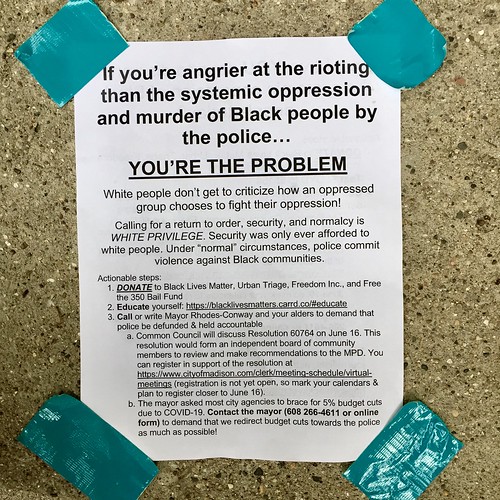
It's "white privilege," we are told, to express a desire for order and security:
A second sign attempts to convince us to abolish the police because they "uphold an inherently racist system" and "protect whiteness and capitalism":
ADDED: I anticipate that my post title will be criticized on the ground that there were a lot of peaceful protesters and we don't know whether any of them participated in anything that can properly be called "rioting." I want to keep the facts straight, and I want to know the facts. I agree that that those who broke windows and looted shops may have been an entirely different set of people from the people who were there to protest police brutality. I await the news reports and investigations that can bring these facts to light. I keep looking!
But that post title is just telling you what the sign says! It's one of the many problems with the sign. Whoever wrote that sign made no effort to separate the peaceful protesters from the rioters. It tells me to shut up about any objection I might have to the rioting because those in the oppressed group get to choose how to fight their oppression. This implies that the form of protest chosen was, in fact, theft and vandalism, and white people are not even allowed to criticize this expression.
"Try to imagine James Brown, the Beatles, Jimi Hendrix, Otis Redding, Bob Dylan, Mick Jagger, David Bowie, Janis Joplin, Elton John, and Prince without his electrical charge. Little Richard was an original, and he did not hesitate to remind his students of their debt. He once looked into a television camera and, with affection, told Prince, 'I was wearing purple before you was wearing it!'... Richard Penniman was born in 1932 into a large, poor Christian family, in Macon, Georgia. His father was a brick mason and a bootlegger. One of Richard’s legs was shorter than the other, making him a source of mockery among other children. 'They thought I was trying to twist and walk feminine... The kids would call me faggot, sissy, freak.'... Even as a child singer, Richard was known for his high range and incredible volume. But, in his father’s eyes, he was unbearably effeminate and not to be tolerated. When Richard was a teen-ager, he was thrown out of the house and went to live with Ann and Johnny Johnson, a white couple who ran a local venue, the Tick Tock Club.... Throughout his teens, he was in and out of outfits like Buster Brown’s Orchestra (where he got the name Little Richard) and the Tidy Jolly Steppers. He sang, sometimes wearing a red evening gown, under the name Princess Lavonne, in Sugarfoot Sam’s Minstrel Show."
It was a medicine show spiritualist pseudo-psychic passing through town named Doctor Nobilio who was the first to tell Richard he would be massively famous—he just needed to get the hell out of Macon. He quit high school and joined up with a series of amazingly-titled rinky-dink traveling shows, initially billed as Little Richard, and then as the great Princess Lavonne. He performed with Dr. Hudson’s Medicine Show, Sugarfoot Sam from Alabam, the Tidy Jolly Steppers, and the Broadway Follies. Princess Lavonne was an intense, hilarious Queen in Pancake 31 makeup. He worked on his schtick, but ultimately was an awkward drag performer. He had a natural gift to electrify and seduce, but with his mismatched legs, he couldn’t figure out how to walk or dance in heels so he would just stand still and wait for someone to open and close the curtain...
I'd also love to hear the story from the perspective of Ann and Johnny Johnson. Who were these white people who took in Little Richard when his father was so cruel to him? Or was his father cruel to him?