Showing posts with label books. Show all posts

Wednesday, March 3, 2021

"Dear Ted, What has happened to us? I don't know. I feel myself in a spiral, going down down down..."

"... into a black hole from which there is no escape, no brightness. And loud in my ears from every side I hear, 'failure, failure, failure...' I love you so much ... I am too old and enmeshed in everything you do and are, that I cannot conceive of life without you ... My going will leave quite a rumor but you can say I was overworked and overwrought. Your reputation with your friends and fans will not be harmed ... Sometimes think of the fun we had all thru the years ..." 

That is the suicide note of Helen Palmer, the first wife of Theodore Geisel AKA Dr. Seuss. Here's her Wikipedia page. She was born in Brooklyn, he was born in Massachusetts, she went to Wellesley, he went to Dartmouth, and they both went to Oxford, where they met. 

She later stated, "Ted's notebooks were always filled with these fabulous animals. So I set to work diverting him; here was a man who could draw such pictures; he should be earning a living doing that."...

For about a decade following World War II, Ted worked to feed a booming children's book market... [relying] heavily on the encouragement and editorial input of Helen. In fact, throughout much of his career, he relied on her support. After realising that her husband was having an affair, Helen committed suicide in 1967 with an overdose of barbiturates after a series of illnesses spanning 13 years. ...

About Helen's death, Ted's niece Peggy commented: "Whatever Helen did, she did it out of absolute love for Ted." Secretary Julie Olfe called Helen's death "her last and greatest gift to him." Eight months later, in June 1968, Ted married Audrey Dimond, with whom he had been having an affair before Helen's death.

That links to a 2000 article in the NYT: 

Audrey Dimond was married with two children when she fell in love with Ted Geisel. Mr. Geisel, 18 years her senior, was also married. In the wake of their affair, Mr. Geisel's wife, Helen, committed suicide, causing, as Mrs. Geisel puts it, ''a rather large ripple in the community of La Jolla.''

Mrs. Dimond divorced her husband to marry Mr. Geisel, 64, and when she did, her daughters, 9 and 14, were sent away to school.

''They wouldn't have been happy with Ted, and Ted wouldn't have been happy with them. He's the man who said of children, 'You have 'em and I'll entertain 'em.' Ted's a hard man to break down, but this is who he was. He lived his whole life without children and he was very happy without children. I've never been very maternal. There were too many other things I wanted to do. My life with him was what I wanted my life to be.''

Did you know and remember this story? I didn't. Had I read it in the NYT back in 2000? I must have, but it was shocking news to me when I encountered it as I was poking around on Geisel's Wikipedia page this morning after blogging about the current to-do over the man. 
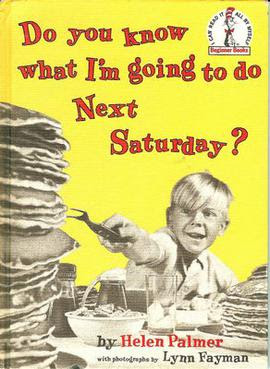
ADDED: Palmer was herself a children's book author. This is her most famous book:

Knowing what happened to her, it's hard not to imagine her answer to the question: Commit suicide! 

And it's hard not to think of the super-greedy boy as Geisel. Some people thought the book was actually written by Geisel, and Snopes took the trouble to debunk a rumor which it states as: "Dr. Seuss once wrote a children's book since banned due to its references to suicide and violence."

The Snopes piece is long and interesting, going beyond getting the authorship straight and delving into why the book could be understood to have a violence problem: 

Some of the prose in Do You Know What I’m Going to Do Next Saturday? does sound a little odd if read without the context provided by its accompanying photographs, a feature the creator of the “Banned Book” page capitalized upon. For instance, at one point the child narrator declares:

Did you ever beat more than one kid at a time?

Well, I’m going to beat five kids at a time.

And then I’m going to beat their fathers, too.

The photos show a boy playing tennis with kids and volleyball with men.

Likewise, the following lines are a little difficult to fathom when considered in isolation:

I’ll dump water on Sam.

I’ll make him take a walk.

I’ll make Sam walk about a hundred miles.

The photos show kids hiking and playing. 

Even the innocuous can sound ominous when taken out of context:

I’ll run around and yell and yell.

Next Saturday I’ll yell my head off.

I’ll blow horns. I’ll blow and blow.

Next Saturday I’ll blow my head off.

No one is going to stop me next Saturday.

In the photo, the kid is playing a tuba, but you can see you don't want to hear your child say "Next Saturday I’ll blow my head off"!

You Know What I’m Going to Do Next Saturday? was never “banned,” and nothing about it was really the least bit unwholesome....

Yeah, well, actually it is. The whole point is that there are double meanings and the photo is always the good meaning, but you can still figure out the dangerous meaning. That's why it's funny. And once you know the author killed herself, aren't you ready to keep it out of the hands of your little darlings?

Friday, June 19, 2020

"White fragility is the sort of powerful notion that, once articulated, becomes easily recognizable and widely applicable.... But stare at it a little longer..."

"... and one realizes how slippery it is, too. As defined by [author of 'White Fragility' Robin] DiAngelo, white fragility is irrefutable; any alternative perspective or counterargument is defeated by the concept itself. Either white people admit their inherent and unending racism and vow to work on their white fragility, in which case DiAngelo was correct in her assessment, or they resist such categorizations or question the interpretation of a particular incident, in which case they are only proving her point. Any dissent from 'White Fragility' is itself white fragility. From such circular logic do thought leaders and bestsellers arise. This book exists for white readers. 'I am white and am addressing a common white dynamic,' DiAngelo explains. 'I am mainly writing to a white audience; when I use the terms us and we, I am referring to the white collective.' It is always a collective, because DiAngelo regards individualism as an insidious ideology. 'White people do not exist outside the system of white supremacy,' DiAngelo writes, a system 'we either are unaware of or can never admit to ourselves.'... Progressive whites, those who consider themselves attuned to racial justice, are not exempt from DiAngelo’s analysis. If anything, they are more susceptible to it. 'I believe that white progressives cause the most daily damage to people of color,' she writes. '[T]o the degree that we think we have arrived, we will put our energy into making sure that others see us as having arrived...'... It is a bleak view, one in which all political and moral beliefs are reduced to posturing and hypocrisy...."

Writes Carlos Lozada in "White fragility is real. But ‘White Fragility’ is flawed," reviewing the book "WHITE FRAGILITY: Why It’s So Hard for White People to Talk About Racism" in The Washington Post.

Thursday, June 18, 2020

"As the book nears publication and details spill out, many congressional Democrats quickly assailed Mr. Bolton for not telling his story during the impeachment proceedings and instead saving it for his $2 million book."

"Mr. Bolton explains his position in the epilogue, saying he wanted to wait to see if a judge would order one of his deputies to testify over White House objections. Once the House impeached Mr. Trump over the Ukraine matter, Mr. Bolton volunteered to testify in the Senate trial that followed if subpoenaed. But Senate Republicans voted to block new testimony by him and any other witnesses even after The New York Times reported that his forthcoming book would confirm the quid pro quo. Some of those Republican senators said that even if Mr. Bolton was correct, it would not be enough in their minds to make Mr. Trump the first president in American history convicted and removed from office. Mr. Bolton blames House Democrats for being in a rush rather than waiting for the court system to rule on whether witnesses like him should testify, and he faults them for narrowing their inquiry to just the Ukraine matter rather than building a broader case with more examples of misconduct by the president. 'Had a Senate majority agreed to call witnesses and had I testified, I am convinced, given the environment then existing because of the House’s impeachment malpractice, that it would have made no significant difference in the Senate outcome,' he writes."
From "Five Takeaways From John Bolton’s Memoir 'The Room Where It Happened' describes Mr. Bolton’s 17 turbulent months at President Trump’s side through a multitude of crises and foreign policy challenges" by Peter Baker (NYT).

ADDED:

Monday, June 15, 2020

"The book will... allege that Trump and his father, Fred Trump Sr, contributed to the death of Trump's alcoholic elder brother Fred Trump Jr by failing to help him."

From "Donald Trump’s niece reveals in new book that she leaked details of his 'fraudulent' tax schemes, alleges he contributed to his brother’s death and says his retired federal judge sister disapproves of him" (Daily Mail).

The niece is the daughter of the brother who died. It's sad to think about what could have been done to prevent a death — sad to look for living persons to blame.

Most of the time, we soothe the survivors and tell them there's nothing they could have done, and when we choose to say, no, there are things you could have done that you did not do, it is probably not because those things were more obvious or had more potential to help.

Sunday, June 14, 2020

"[W]hen things get real — really murderous, really tragic, really violent or aggressive — my white, liberal, educated friends already know what to do. What they do is read."

"And talk about their reading. What they do is listen. And talk about how they listened. What they do is never enough. This isn’t the time to circle up with other white people and discuss black pain in the abstract; it’s the time to acknowledge and examine the pain they’ve personally caused. Black people live and die every day under the burdens of a racism more insidious than the current virus that’s also disproportionately killing us. And yet white people tend to take a slow route to meaningful activism, locked in familiar patterns, seemingly uninterested in really advancing progress. Theirs is still a world of signs and signaling, where actions like joining book clubs — often based in some 'meaningfully curated' readings that are probably easy to name: 'White Fragility,' 'How to Be an Anti-Racist,' 'Between the World and Me,' maybe even 'All About Love' — take precedence.... [In social media] people write long posts about the need to examine white privilege, to 'name white supremacy,' and to either proudly denounce family members or call them in to conversations.... ... I know what happens next. In a handful of Sundays, my social media feeds will no longer have my white allies 'This'-ing, or unpacking their whiteness or privilege, or nudging their kids to put down their tablets and march. Their book clubs will do what all book clubs do: devolve into routine reschedulings and cancellations; turn into collective apologies for not doing the reading or meta-conversations about what everyone should pretend to read next; finally become occasional opportunities to catch up over wine...."

From "When black people are in pain, white people just join book clubs/I’m caught in a time loop where my white friends and acquaintances perform the same pieties over and over again" by Tre Johnson (WaPo). If you're wondering what, in Johnson's view, is the right response, I can pick out the 2 words where he says it, and when you see them, you may think it's no wonder white people don't just snap to it and do what needs to be done: "dismantle systems."

ADDED: I read the top few highest-rated comments at the link, and they were all taking issue with Johnson's stereotyping of white people. What percentage of white people react to racial strife by cuddling up in book clubs murmuring about "White Fragility" and "Between the World and Me"?